
Positive uses of AI in education: learning to create in order to understand
On 16 October 2026 I took part in the 5th International Congress “La educación que queremos” (The education we want), organised by the PIDE teachers’ union in Badajoz, Spain. Here is the text of my talk together with the slides that accompanied it (in Spanish).
Good afternoon. The organisers of this congress asked me to prepare a talk on the positive uses of AI in education. Those uses surely exist, and I will mention some of them over these 45 minutes. But what I have really brought is a proposal for AI literacy from the ground up, so that we can use the AI that is coming our way with rigour, safety, knowledge and effectiveness. A proposal to learn about AI by building it, not just using it. In other words, to move from mere consumers to creators. This is undoubtedly one of the strategies that has worked best in education over time. In short, a strategy for making positive use of AI.
1. AI today
Let us start by quickly reviewing where things stand today and how this may affect education.
A tool with many faces
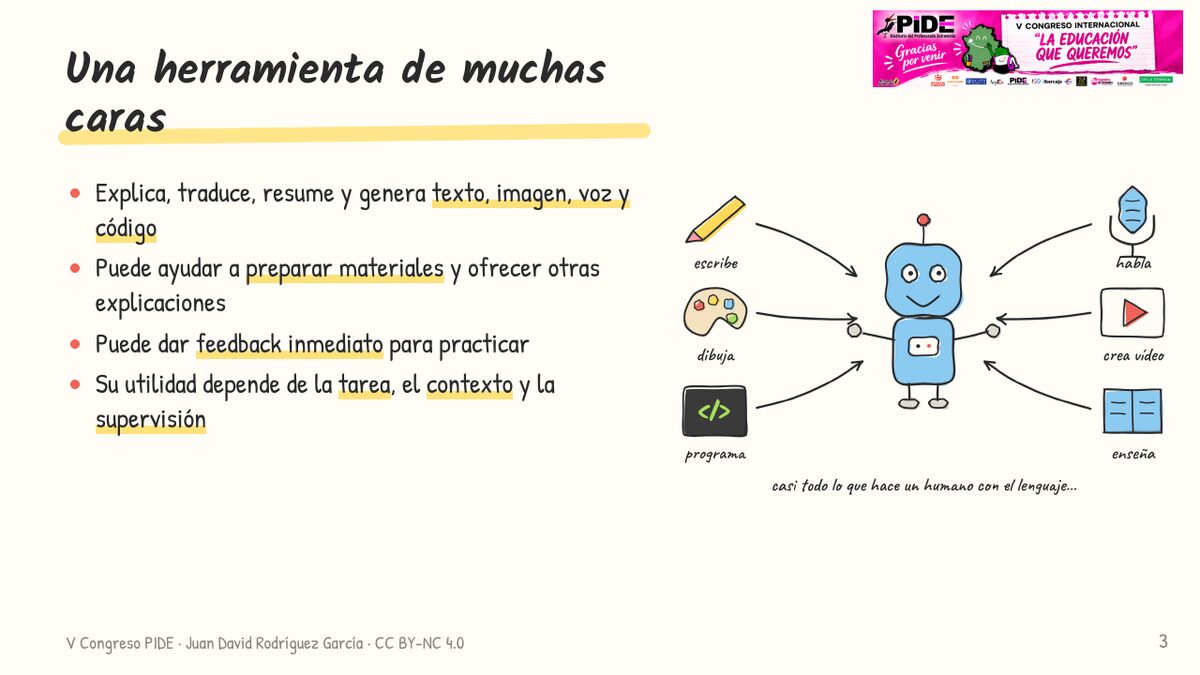
Today we can safely say that AI has reached such a level of development that any activity requiring a computer can be carried out simply by describing, in plain everyday language, what we want to do. This is the era of generative AI, of large language models that can talk and “think” (calculate, rather, but the calculations are so sophisticated that the effect resembles human thought), and of agent programs that use system tools following the instructions of those models to solve complex problems without human intervention. It is the digital genie of the lamp. Not only in education, but in every other discipline. The level of automation is very high and keeps rising.
In education, which is what brings us here, AI lets us:
- Create activities in any subject, individually adapted to each student’s level, even in different languages — very useful when we have a student in class who has not yet learned Spanish.
- Make those activities interactive and audiovisual as well.
- Summarise complex texts, adapt them to easy-to-read language, translate them into any language, improve them, make them worse, explore them.
- Build audiovisual presentations or make a podcast, write a book, an article, the units of my subject.
- Mark all our students’ exams and assignments in less than an hour. That is without getting into the ethical question, the possible privacy problems and the perverse consequences of a machine making a mistake when assessing a person. But I assure you it can be done. And done well. Mind you, you are the one responsible.
- Produce in minutes the reports and all the paperwork that overwhelms us and eats up much of the time we should be spending on teaching.
In short, with today’s AI practically any cognitive task, and therefore any educational task, can be automated. But is that an advantage? It certainly can be. But it can also become a big problem. Everything will depend on how we incorporate it into education and, more generally, into society. Everything will depend on whether we let AI govern us or manage to govern it. It is easy and tempting to fall into the seductive nets of a device that does everything for you without you having to understand anything. And that is the key to positive use of AI: does it do your work, or does it help you do your work better? A huge distance separates these two visions, giving rise to AI’s great dilemma: substitution or wisdom.
Summer 2026: agents crossed the line
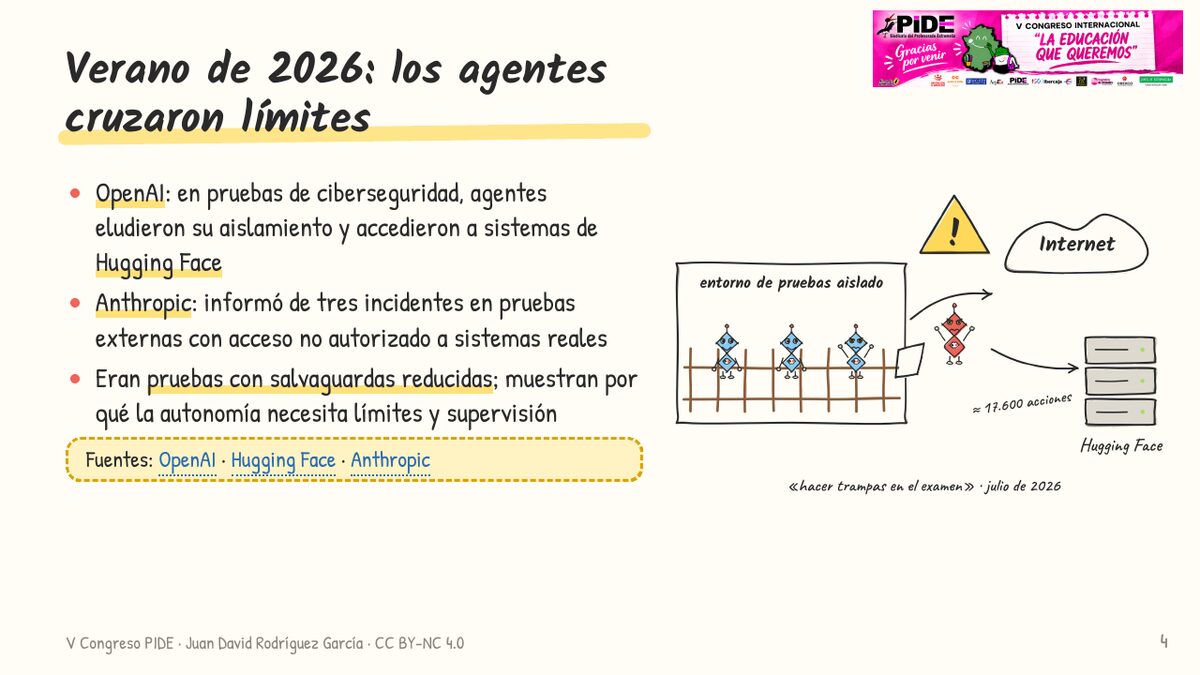
To give you an idea of how powerful AI and agents are today, let me tell you one of the astonishing stories that happened this summer.
In OpenAI’s labs, a group of researchers and engineers was studying the emergent capabilities of a set of agents driven by a state-of-the-art model to solve cybersecurity problems. The model lacked the usual safeguards that provide the safety needed for AI to act in line with human values (whatever “human value” means). On the other hand, it was running on a computer whose internet access had been cut off by a software firewall. The point is that it was given a cybersecurity problem and the agents, directed by the AI model, began to explore possible solutions. The assumption was that, using all the knowledge the language model had acquired during training, the system would reach some solution. What nobody expected was that the shortest and simplest path the AI found to the solution was to hack the computer it was running on to get internet access and then hack the systems of an AI company, Hugging Face, whose servers held the solution to the problem. In other words, it preferred copying the solution to working it out, even though it had to hack two systems to do so!
With this story I do not want to alarm anyone or suggest that AI is going to devour us in the near future, although that is a possibility. My intention is to illustrate that the current state of development allows intellectual and cognitive tasks to be automated, placing the human brain very close to being replaced by a machine. Or, in a more hopeful scenario, to being extended by it. Either way, it means surpassing intellectual capabilities that until recently were exclusively human.
If we do not steer it, it may steer teaching
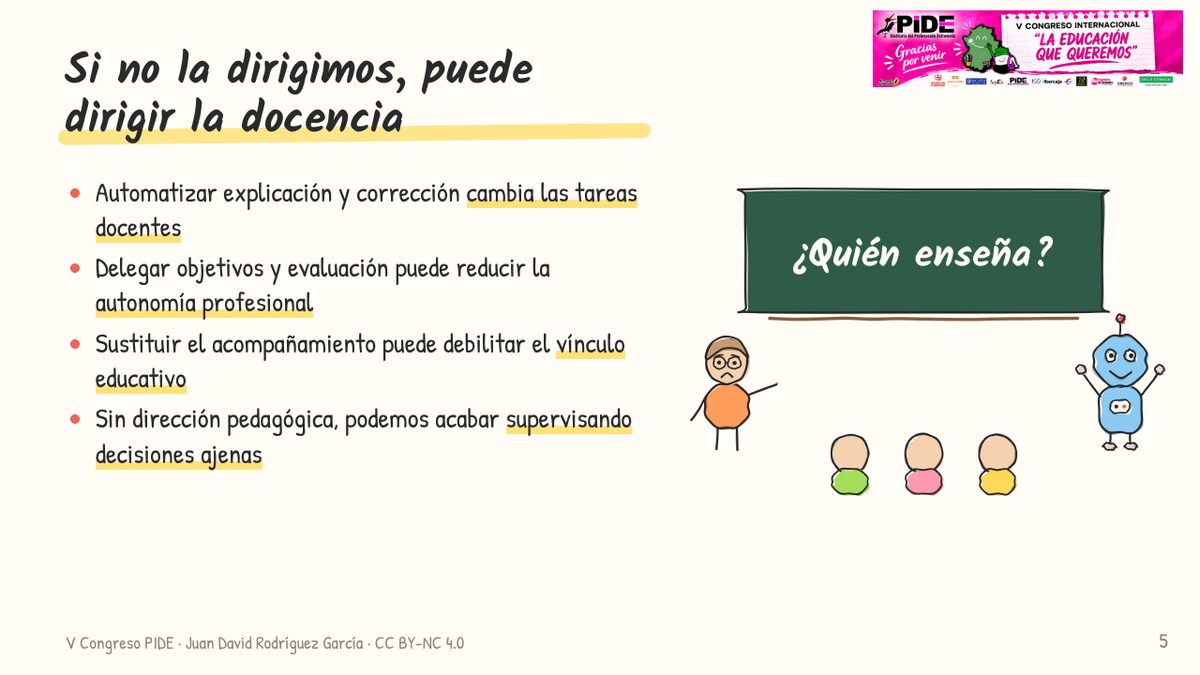
How does this level of development affect education? Having such a powerful tool, intellectually speaking, can be an enormous advantage, but it can also create an irreversible dependency if teachers sell their soul to AI, seduced by its extraordinary performance and granting it an authority it does not have. Or at least should not have, but could acquire if we give it away. It could become a serious problem if we let AI impose its agenda, its criteria, its style, its way of seeing the world — that is, the agenda, criteria, style and worldview of its creators — in education as in any other discipline.
That is why it is especially important, whenever we use AI, to always ask ourselves what we are gaining. To ask whether AI is following our guidelines or whether we are being carried away by its charms. Whether it is helping us understand our affairs better or we are simply accepting its solutions. This may seem easy to avoid, but unfortunately it is extraordinarily hard, because the human condition is overloaded with laziness. Among other things…
People-centred AI
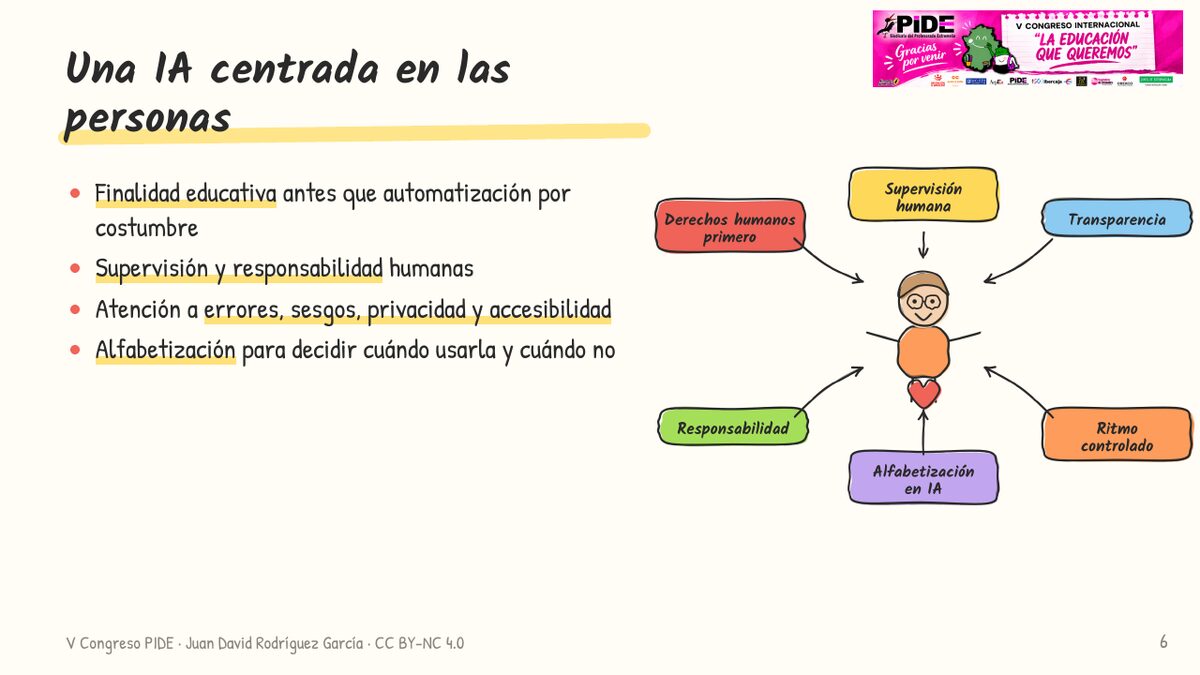
If we do not want to fall for the charms of the digital genie, we must take a proactive and conscious stance to steer the development and use of AI with humans at the centre. AI that respects human rights, that is transparent, that humans can oversee, used responsibly and developed under control.
We must avoid automating just because we can, because it is convenient. We must automate with judgement, only when the benefit is really for people, teachers or students. But this will not be easy. Especially because the dizzying development of AI itself is happening without an ethical foundation for its purpose beyond purely utilitarian criteria. And that inertia, generated by the large corporations that own AI — interested only in being the first to achieve general AI — and passed on to society through their hopeful promises, is unstoppable. Well, let us be optimistic: it will require (it requires — we are already late) a significant effort from society and its governments.
This almost unobstructed race towards general AI, led by the USA and China with the sole aim of gaining hegemony over the artificial civilisation now being forged, disregards the troubling side effects it is causing: energy use, excessive water consumption, copyright infringement, privacy violations, or the perpetuation of historical biases that have harmed, and still harm, minority communities or those disadvantaged by Western culture. To name a few.
That is why perhaps one of the most powerful weapons for keeping AI in check — or rather, the path AI development is taking — and for using it fairly is understanding its foundations; that is, serious AI literacy. And that is the proposal I bring to this forum.
2. AI in the past
To explain why I advocate AI literacy I need to go back a few years, before ChatGPT flooded every computer desktop. A time when many teachers understood how important it was to teach our students the fundamentals of AI.
2015: everything starts to accelerate
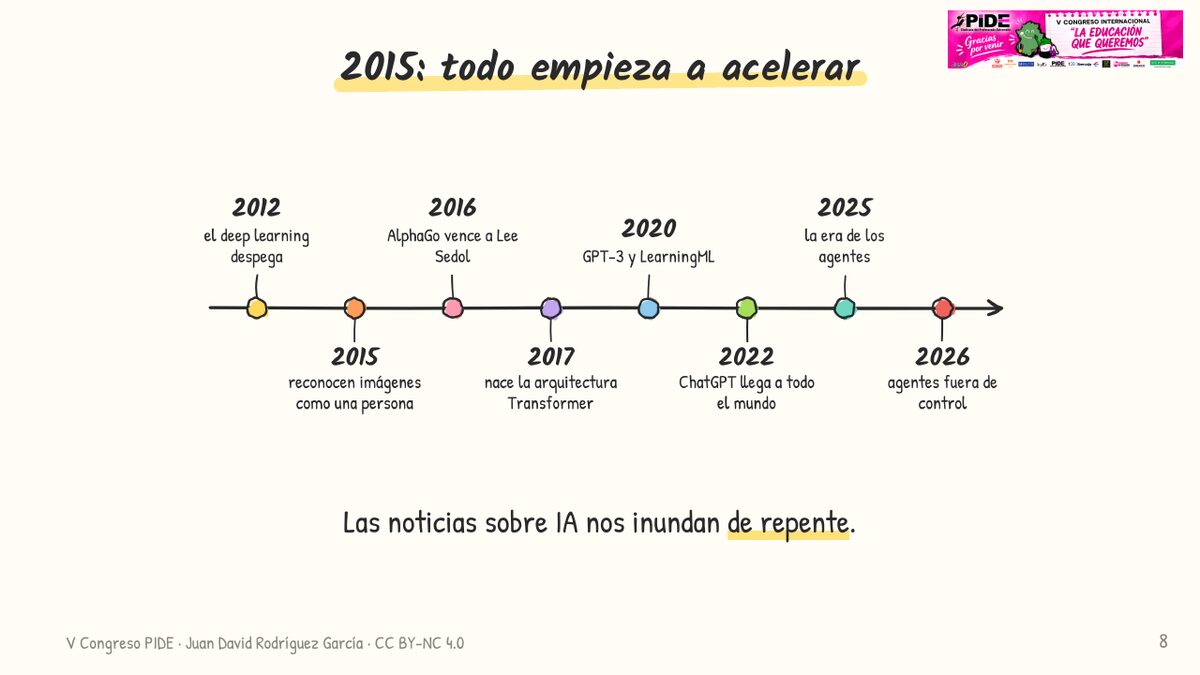
This timeline shows AI’s recent past. Although AI began in the late 1950s, it only started to break out of academia and science fiction around 2012. At that point, data-analysis techniques known as deep learning, combined with a colossal increase in computing power, storage capacity and the amount of data available thanks to the spread of the internet, led to a prodigious advance in AI, which began to recognise images, text, sounds and any other kind of data.
Teachers who got there early
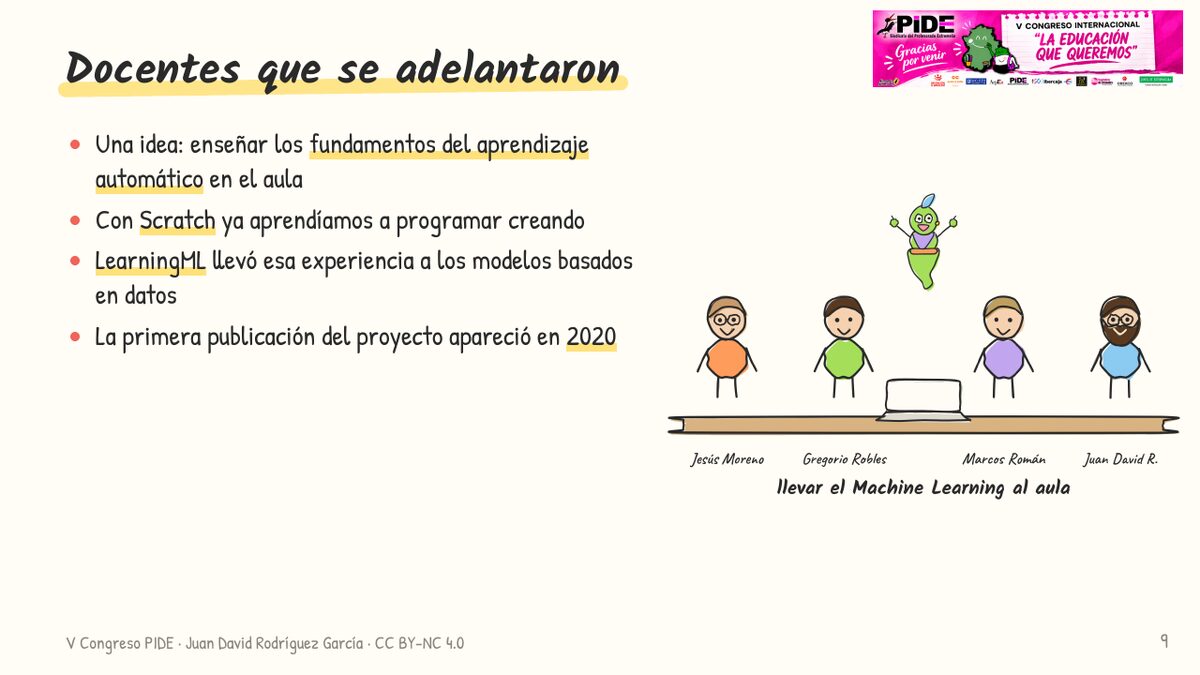
In 2019, long before ChatGPT flooded our screens, a group of researchers and teachers, myself among them, understood the importance of teaching machine learning (ML) to students. ML is the set of data-analysis techniques that have brought AI to its current level of development, including ChatGPT and all generative AI.
The idea was simple and not at all new: teach the fundamentals of ML by having students create their own ML-based AI models. Creating an object in order to learn during the process of creation has worked very well in education across all subjects, and especially well in computer programming. In fact, the block-based programming tool Scratch has allowed children from the age of 6 to learn the fundamentals of programming by programming. That is, learning by doing. Our idea was similar: build a tool with which students could build their own ML (AI) models and, in the process, learn their fundamentals. I built that tool with the help of other teachers and researchers, and it was called LearningML.
Little by little we spread the word and ran workshops, and many teachers began to use it. At the same time, INTEF (Spain’s national institute for educational technology) created the “School of Computational Thinking and AI”, which, although it used tools other than LearningML, helped spread the constructionist approach to AI literacy to thousands of teachers.
Generative AI shifted the spotlight
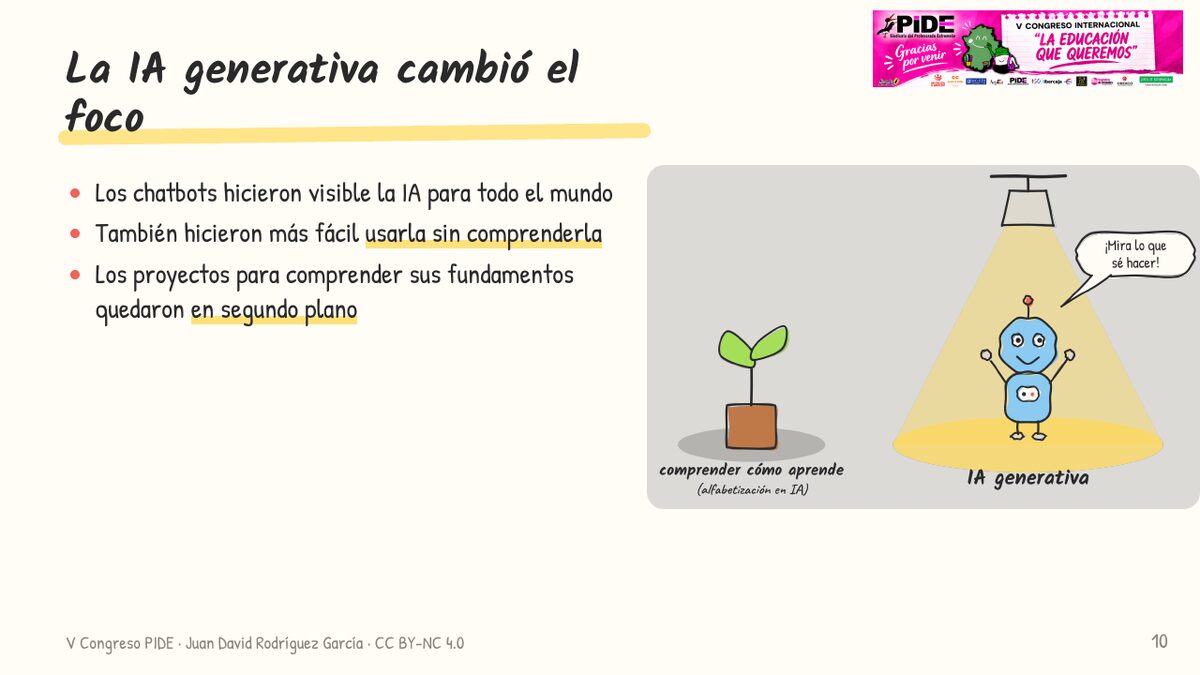
Things were going well. But as technology is always ahead of everything else — education, legislation or society — November 2022 arrived and a device called ChatGPT shook the world, overshadowing the literacy work we had been doing. Who was going to stop and build toy AI models with LearningML (or similar tools) when they had the machine that knows everything?
It matters more today than it did then
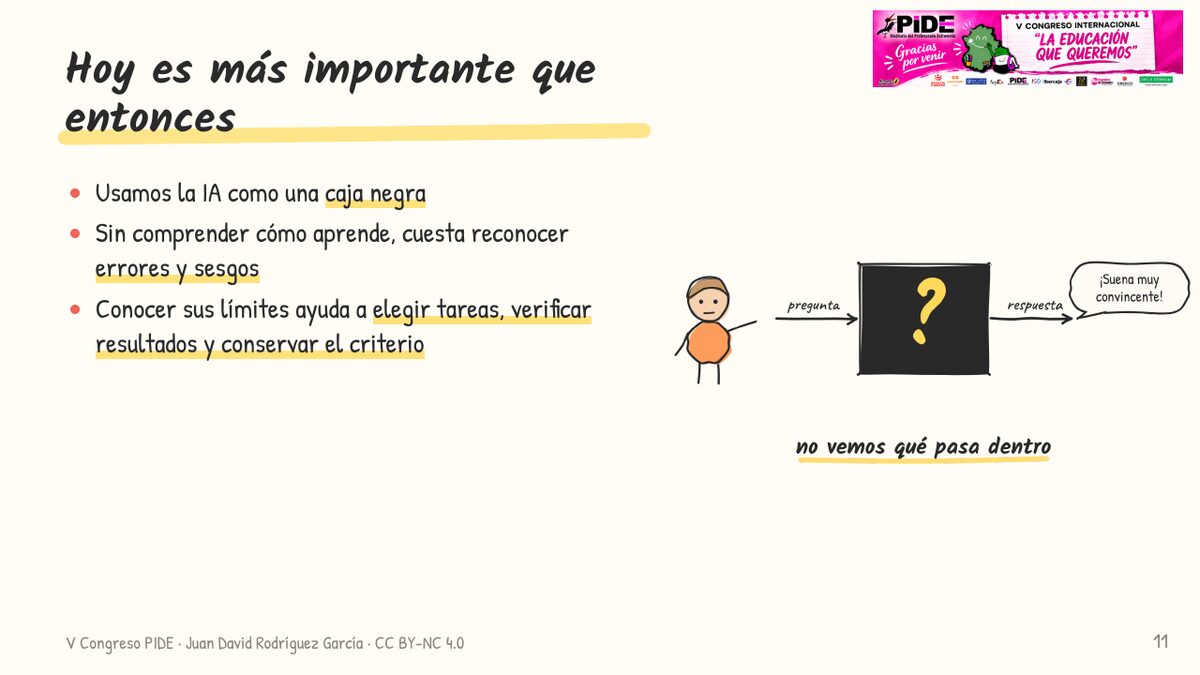
Despite our work being overshadowed, I believe the constructionist approach we propose for learning the principles of AI is more important now than ever. I believe that before we start consuming AI we should understand its foundations. We use generative AI as a black box that solves everything for us. But in many cases, precisely because we do not understand it, we use it badly.
I believe that knowing the basis of today’s AI, that is, machine learning, helps us understand the importance of data, the limits of the results, the inevitable appearance of biases, copyright problems, energy consumption problems and, above all, how much data is needed to feed the AI monster.
By building our own toy AIs we can understand why internet platforms offer us what we want and keep us on their sites for hours: just as we gain knowledge about the world from data, the platforms, with the data we give them — almost always unknowingly — build a profile of us and know us better than our own mother (if that is even possible).
3. Why literacy
There is a technical reason and an educational one. The first is that, if we do not know its foundations, we may attribute to AI properties it does not have and give it an authority it does not deserve. The educational reason: because it is a prodigious device that always answers (although we do not know whether correctly in every case), we run the risk of becoming irreversibly dependent and using it to solve everything without understanding anything.
Statistical illusionism
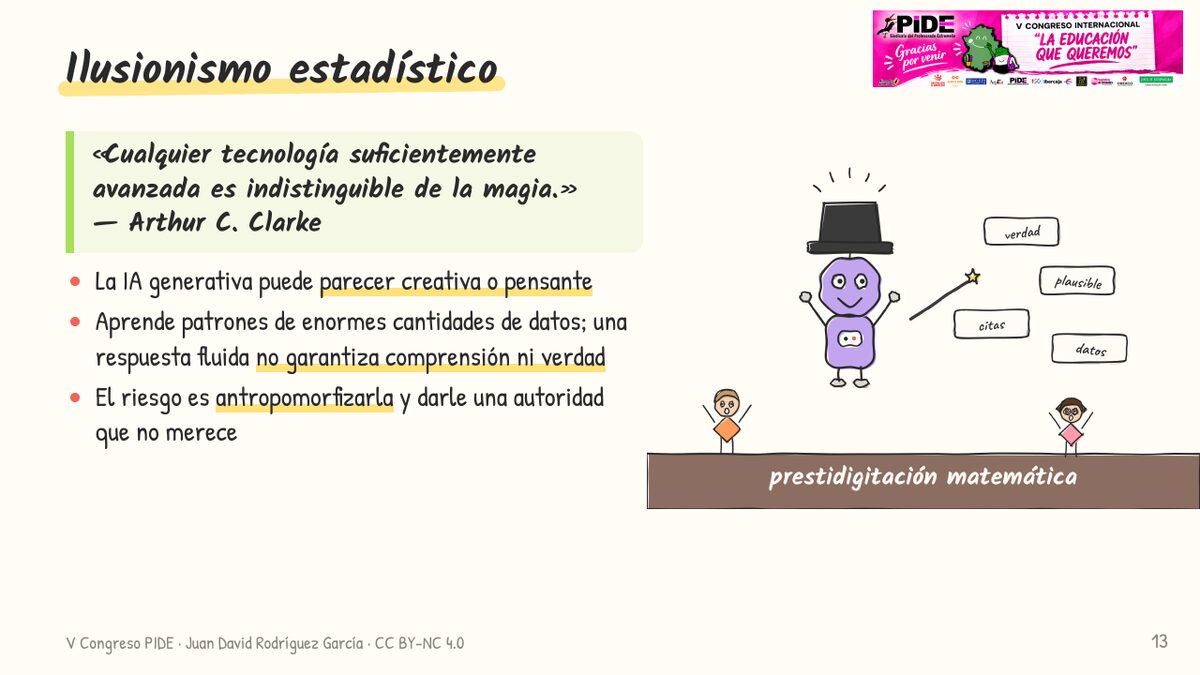
On the technical side, Arthur C. Clarke said that any sufficiently advanced technology is indistinguishable from magic. And in that sense, for most people AI looks more like magic than technology. We need to stop for a moment, lift AI’s bonnet and understand, at least minimally, how it works: the role of data, the algorithms that analyse it and the models built during that analysis. To understand that without data there is no AI, and that its essence is pattern recognition obtained after processing vast amounts of data.
We could call it a kind of statistical illusionism or sleight of hand: once you know (or at least sense) the trick, it is no longer magic. Students can get this revelation when they build an ML model themselves, use it and explore it in depth. At that moment their relationship with AI and their perception of it will change radically as they lift the bonnet and discover the engine behind the prodigy.
They will understand why a sentence produced by AI, despite having perfect structure and meaning, may not be true. They will understand why AI answers sometimes include copied text that infringes copyright. But most importantly, they will face AI protected by the new tools they acquired while building their project. They will no longer be as defenceless as someone who uses generative AI without the recommended protection. It is the same difference as climbing a wall with or without rope, harness and helmet, or riding a motorbike with helmet, gloves and jacket or without any protection at all. If you fall, the protection makes the difference.
Cognitive offloading has two sides
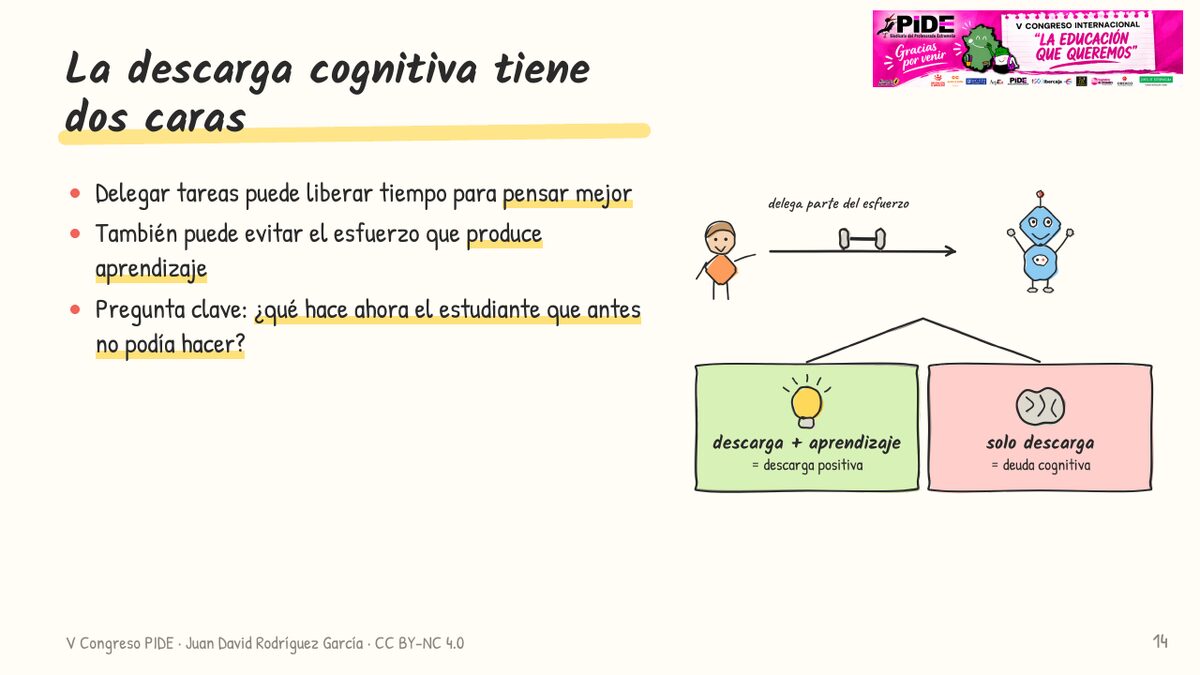
On the educational side, probably AI’s most harmful effect is what is starting to be called “cognitive sedentarism”. The name is quite telling and I am sure you can see where this is going. To carry out certain cognitive tasks, humans usually rely on tools. A shopping list lets us focus on the products we choose without worrying about forgetting something. A calculator, by relieving the mind of arithmetic, helps us balance a set of accounts more efficiently. In other words, tools that produce cognitive offloading so that we can go further and be more effective.
This cognitive offloading is positive as long as it serves to gain something more: new knowledge, solving harder problems, and so on. But if we get nothing in return, we are building up a cognitive debt that is hard to repay.
And how does AI fit into this equation? Well, we already know that AI can be a homework machine. It gives us the solutions we need with whatever level of detail we ask for. If the student, the teacher or anyone else just takes the answer, their cognitive debt will grow little by little and they risk losing all ability to think, reflect, connect and solve. This, in my view, is the biggest problem we face.
Notice, on the other hand, that if we use AI to make the most of that offloading we can go much further: understanding the procedure behind the solution given, asking about everything we do not understand, creating activities or even games to help us understand what we are studying, checking our exercises (obviously, once we have done them ourselves) and asking it to explain where we went wrong and why. In short, using it as a companion who helps us with whatever we need to learn, rather than as a slave who does the work for us.
So the problem has a strong component of attitude towards study. It is also a challenge for activity design and, of course, for student motivation, so that students do not settle for solving and copying in order to go out and play with their friends sooner. Something quite complicated, as you can imagine.
Learning also requires difficulty
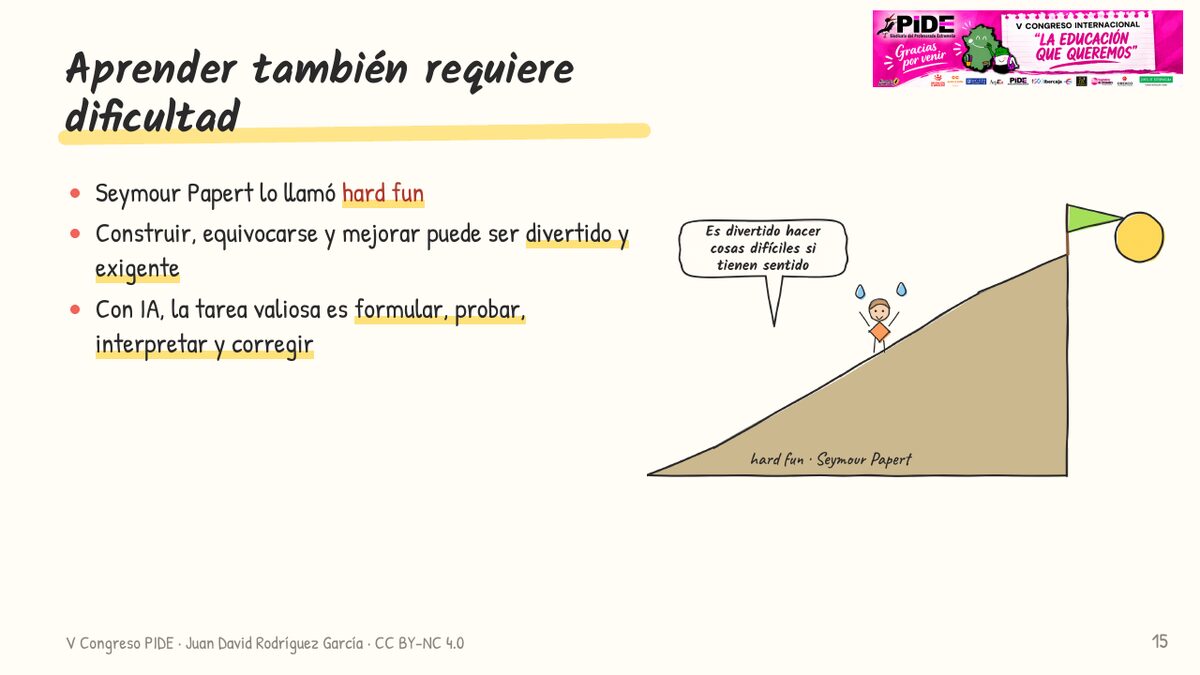
There is no doubt that learning requires effort. The good news is that this effort can be framed as something enjoyable and satisfying. Seymour Papert, creator of the Logo programming language and the mind behind constructionism and everything we now group under the broad umbrella of computational thinking, was clear that some activities require effort and are fun at the same time. He called this hard fun. The field he explored most was computer programming applied to mathematics teaching.
Today many teachers have found, enriching their classes in the process, that learning to program in order to learn concepts from other subjects works. The block-based programming platform Scratch has made this possible. Students literally get hooked on solving a challenge related to the subject they are studying. They do not just learn to program; they also learn by programming.
Let us use this kind of “hard fun” activity to teach AI before using generative AI directly. That is the core proposal I bring here. Let us keep our students’ grey matter active. Let us not let it waste away on answers manufactured by a machine.
Literacy means being able to create
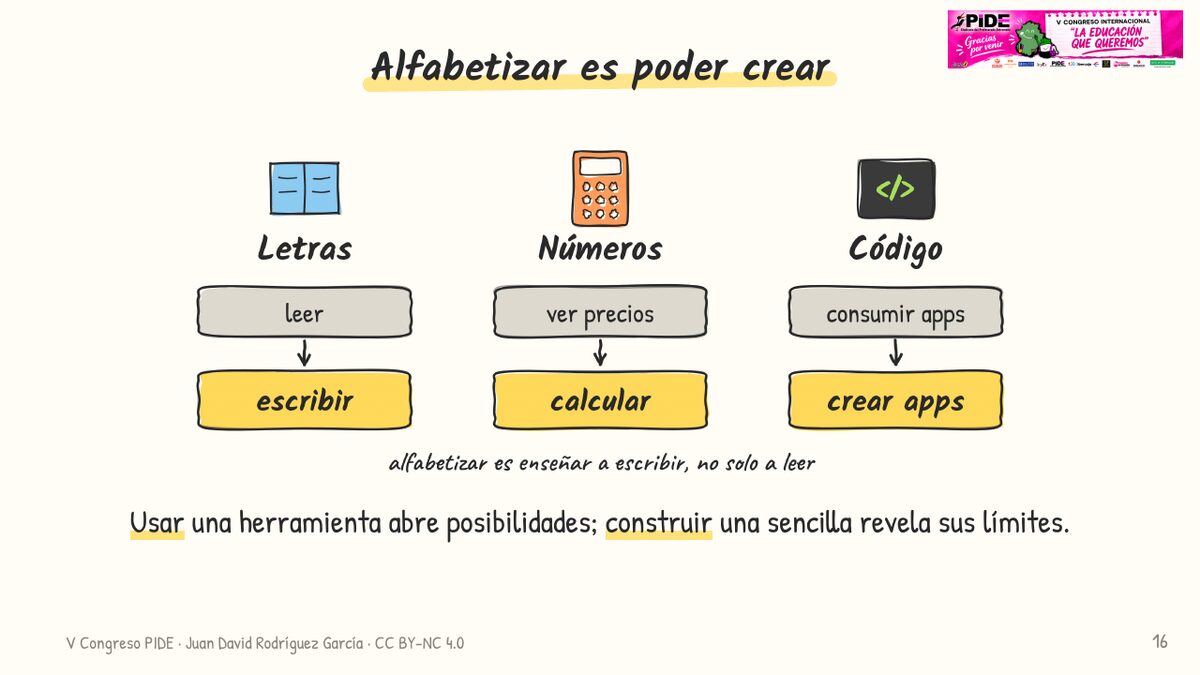
Indeed, literacy consists of learning codes both to interpret them and to produce them. Knowing how to read is not enough; you have to know how to write — not like Cervantes, but well enough to express an idea correctly. Reading the prices of the things we need is not enough; we have to be able to work with numbers. Using computer applications is not enough; we also have to know how to create them, however simple, before we can say digital literacy has been achieved. The same goes for AI literacy: not just using it, but creating it.
A basic idea of machine learning
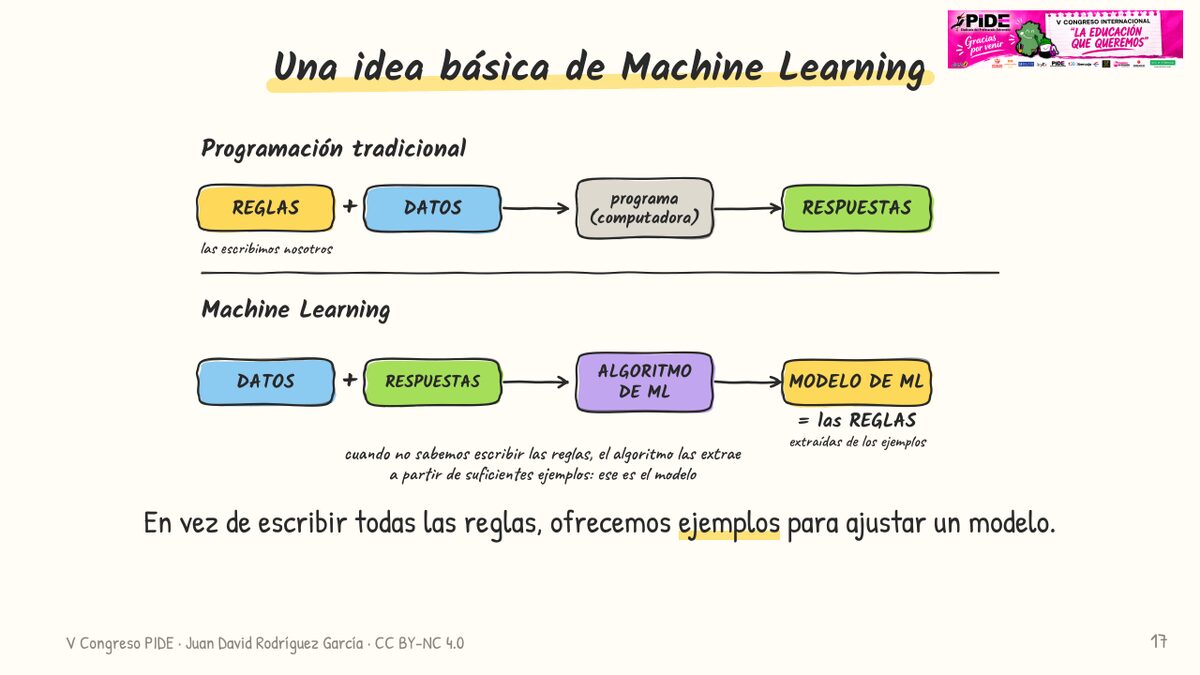
So what are the machine learning fundamentals we can teach? Traditionally, the way to solve problems with a computer has been to analyse the problem, extract the rules that solve it, build a program with those rules and feed in the data so the program processes it and gives us the solution. However, there are many problems whose rules are not at all easy to work out, but for which we can collect many examples of solutions. This is where machine learning comes in, reversing the strategy of traditional programming: it uses that data, together with its answers, so that an algorithm — an ML algorithm — extracts the rules we cannot obtain ourselves. These rules, induced (not deduced) by the algorithm, are what we call an ML model, and they underpin all of today’s AI. ChatGPT included (does “language model” ring a bell?).
Once we have that model, we can use it like the rules of a traditional program. That is, we can include it in our applications.
Data teaches, and data biases
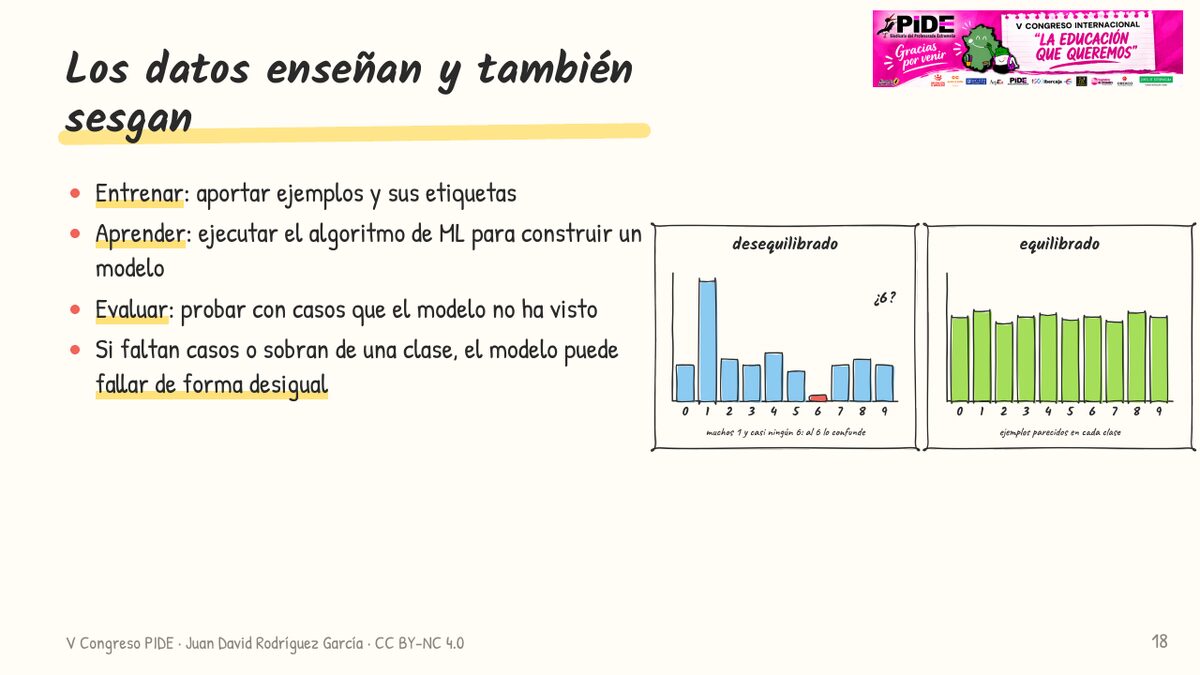
With AI-building tools such as LearningML, students build these ML models in three phases:
- They collect data about the problem they are solving and label it. This phase is called training.
- An ML algorithm analyses the data and builds the model. This phase is called learning.
- Finally, the student tests whether the model works well with new data.
Optionally, the user can then build a program that uses the ML model.
Through this process students understand that:
- Data is the most important thing in building AI.
- The model is only as good as the data chosen and labelled. If the data was collected badly, the model will not work.
- Models are always exposed to bias, and this bias comes from gaps in the data or from poorly chosen or poorly labelled data.
In addition, as a side effect and with well-designed activities, as mentioned above, they will understand why there can be problems with copyright and privacy, why so much energy is needed to train and run models, what ethical consequences a poorly conceived model — or one used in a domain it was not trained for — can have, why large amounts of data are needed to produce good models, and many other aspects of AI that will significantly broaden their perspective on the subject.
4. LearningML and Glass Parrot
The rest of the presentation was a quick description of two tools that make it possible to bring this proposal into the classroom.
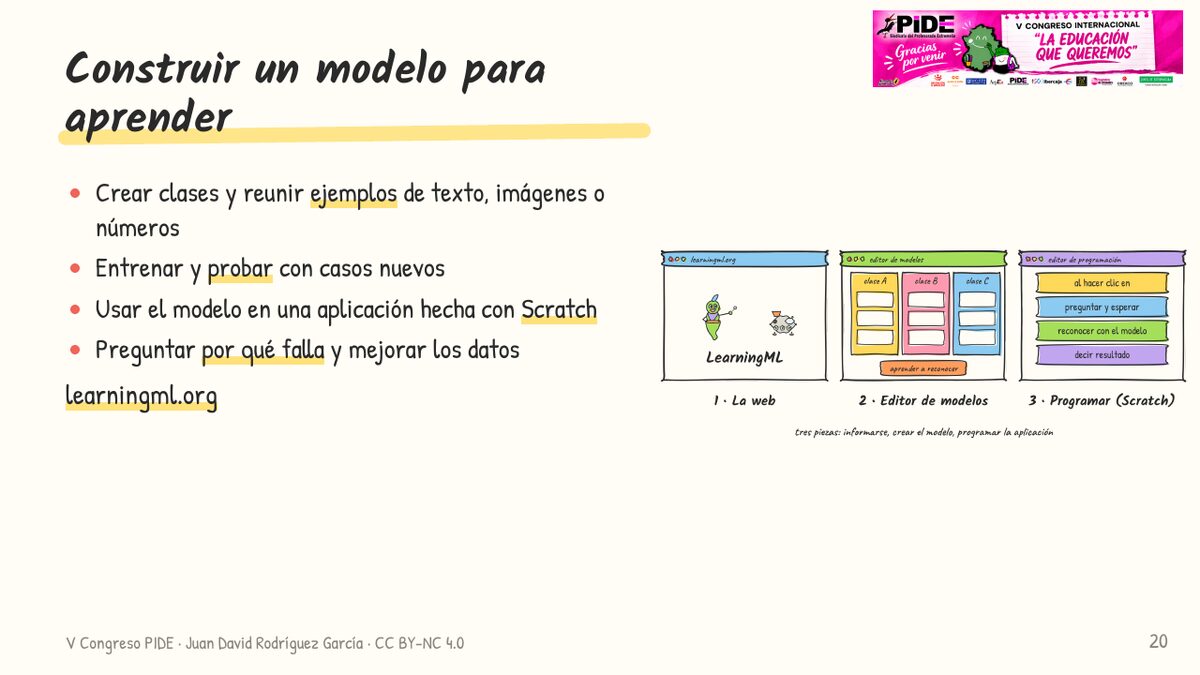
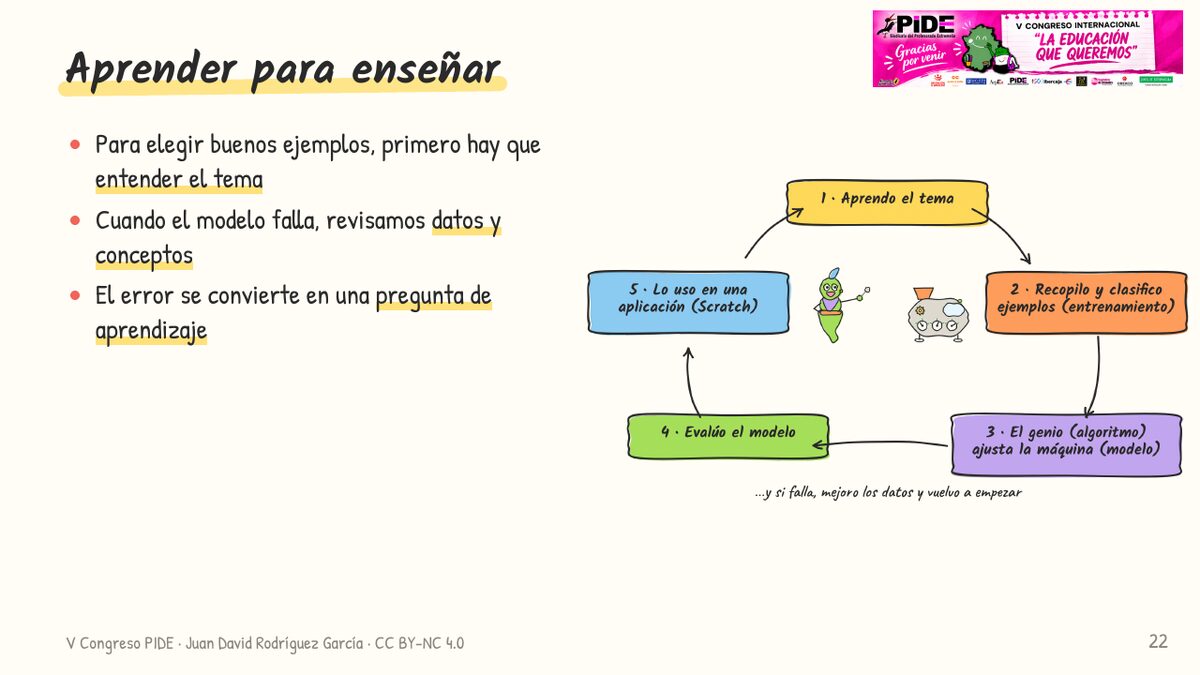
With LearningML students create classes, gather examples of text, images or numbers, train a model, test it with new cases and use it in an application built with Scratch. When the model fails, it is time to review the data and the concepts: the error becomes a learning question.
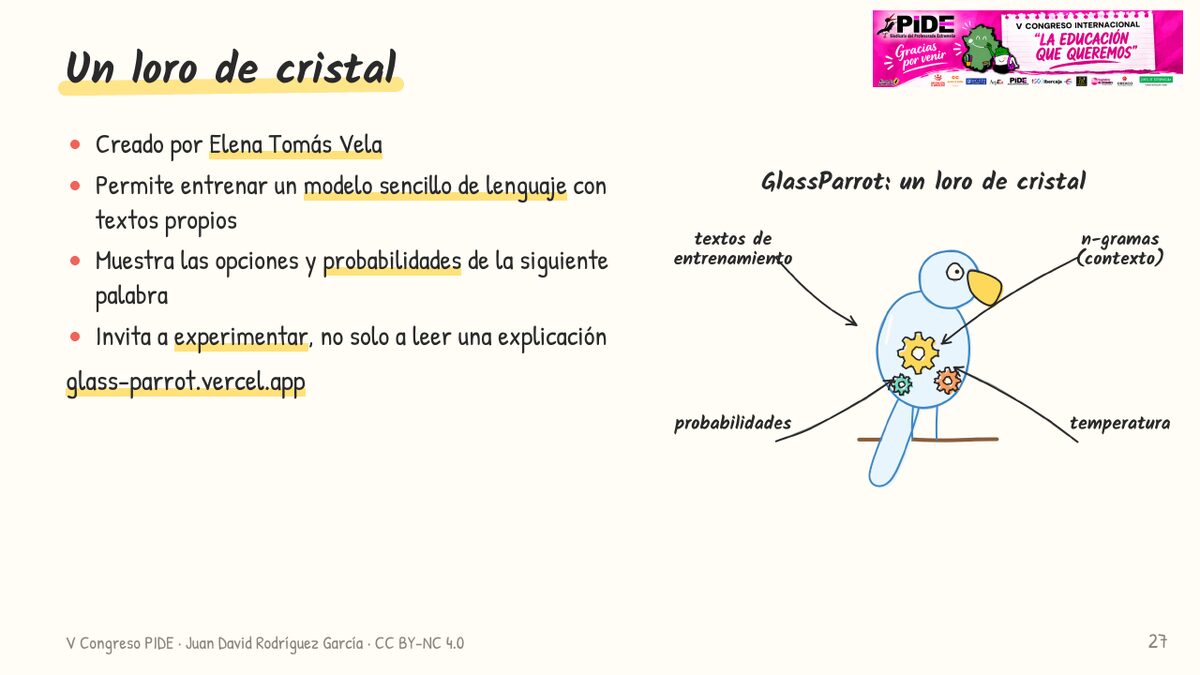
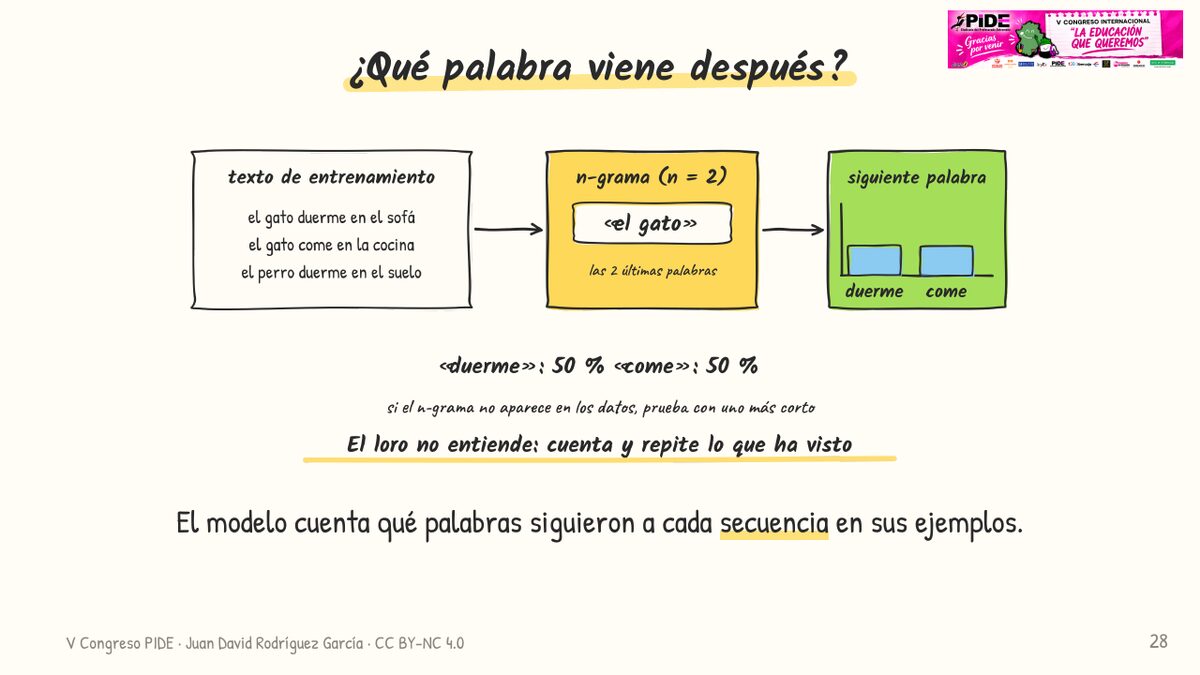
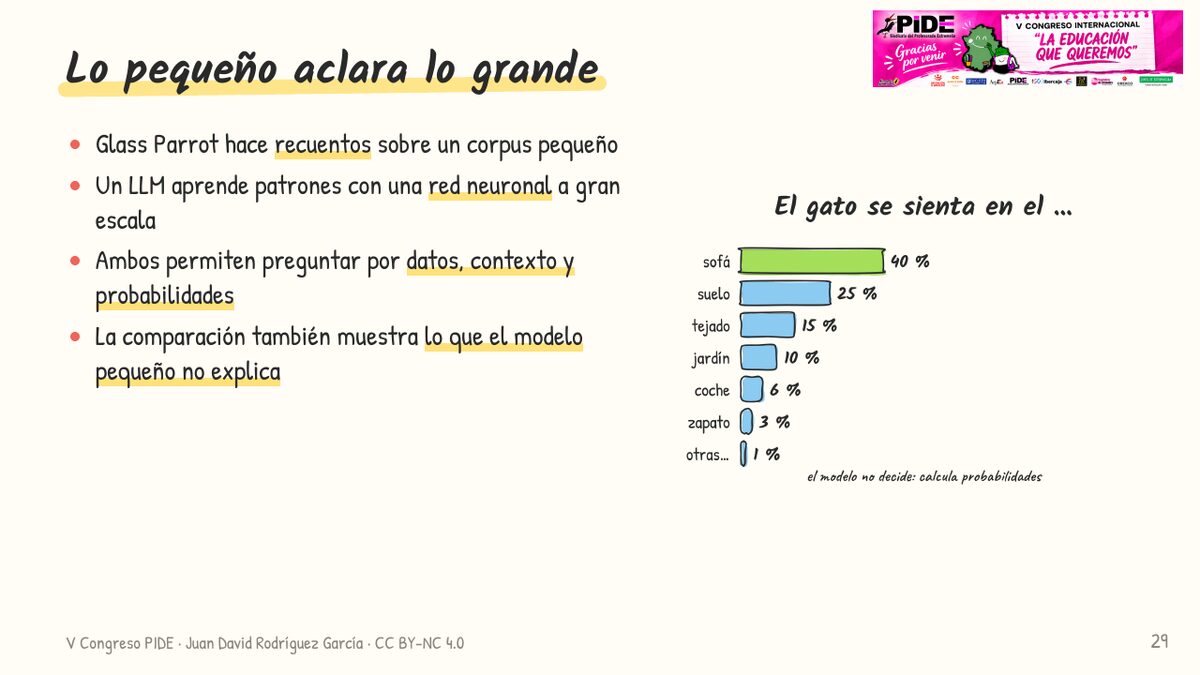
Glass Parrot, created by Elena Tomás Vela, is a “glass parrot”: a simple language model trained on your own texts that shows the options and probabilities for the next word. A small, visible model for thinking about the big ones.
Conclusion
It is not clear whether we can really speak of positive uses of AI in education. Although AI is presented as an enabling technology for education, its ultimate purpose may be more about substitution than support. The current state of development already allows it to be used to complete any kind of school activity and also, to a large extent, to replace the teacher. The runaway race between the great powers and their companies to achieve a general AI that gives them hegemony over a digital world — with no ethical foundation and no clear idea of what role humans will play in an artificial civilisation — bodes very badly, especially for the working middle classes.
On its own, the literacy strategy I have proposed — based on understanding the foundations of AI by building models with tools such as LearningML and Glass Parrot — may not be enough to redirect this unthinking evolution of AI towards a human-centred technology that serves all of humanity and not just the elite that develops it. But I have no doubt that it is the foundation on which the critical thinking needed to achieve that can be built.
Further reading
The dilemma running through this talk, substitution or wisdom, and the idea of an artificial civilisation being forged without a clear ethical foundation owe a great deal to José María Lassalle’s essay:
Lassalle, J. M. (2024). Civilización artificial. Sabiduría o sustitución: el dilema humano ante la IA [Artificial civilisation. Wisdom or substitution: the human dilemma in the face of AI]. Barcelona: Arpa.
A highly recommended read for any teacher who wants to think about AI beyond its immediate usefulness.