
LearningML and the AILit Framework: an opportunity to bring AI literacy into the classroom
In recent months, a key reference framework for artificial intelligence education has emerged: the AILit Framework (AI Literacy Framework), promoted by the European Commission and the OECD. Its goal is clear: to help students not only use AI, but also understand it, evaluate it, and use it critically and responsibly.
This framework proposes that AI literacy is built on three pillars:
- Knowledge (how AI works)
- Skills (how to interact with it)
- Attitudes (how to use it ethically and responsibly)
And it organizes all of this into four major ways of interacting with AI:
- Engaging with AI
- Creating with AI
- Managing AI
- Designing AI
In short, AILit is a practical guide for integrating AI into the classroom in a structured way.
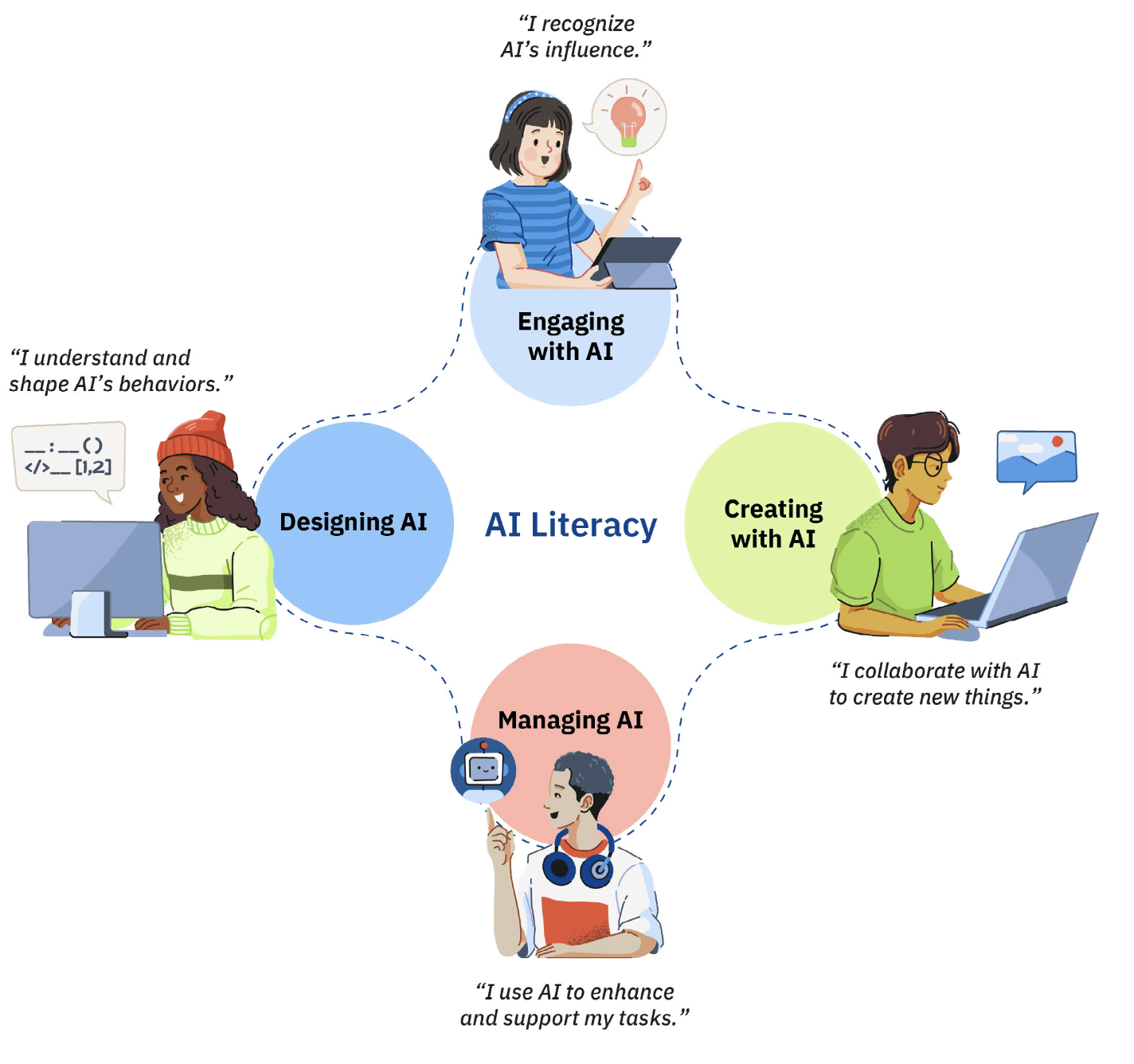
Image taken from the AILit framework review draft: AILitFramework_ReviewDraft.pdf.
Where does LearningML fit in?
This is where LearningML brings particularly strong value.
While many current tools focus on using AI (for example, generating text or images), LearningML makes it possible to go one step further:
teaching how AI works from the inside by building it.
And this connects directly with the AILit Framework approach.
1. Understanding AI (Engaging with AI)
The framework emphasizes that students should learn to:
- recognize when AI is being used
- question its results
- understand its limitations
With LearningML, students:
- train simple models
- see when they fail
- understand that AI does not “know”, but rather predicts
This helps break the idea of AI as a “magic box”.
2. Creating with AI
AILit proposes that students collaborate with AI creatively.
With LearningML:
- students create their own models
- integrate them into projects (for example, with Scratch)
- experiment with results and improvements
In other words, they do not just use AI to create things… they create the AI they later use.
3. Managing AI
Another key aspect is learning how to decide:
- when to use AI
- when not to use it
- which tasks to delegate
LearningML supports this because it:
- forces students to think about what problem they want to solve
- makes it obvious when a model is not working well
- shows that AI is not always the best option
This introduces a fundamental idea: using AI also means knowing when not to use it.
4. Designing AI — LearningML’s strongest connection
This is where LearningML fits the framework almost perfectly.
AILit suggests that students should:
- work with data
- understand training
- detect bias
- evaluate models
LearningML allows them to do exactly that:
- collect and label data
- train machine learning models
- test and improve them
- analyze errors and bias
In short, this is active learning, not just theory.
Much more than a tool
The AILit Framework makes a current challenge very clear:
students already use AI, but they do not always understand it.
LearningML responds directly to this challenge:
- it turns AI into something students can manipulate
- makes its operation visible
- fosters critical and computational thinking
In summary
The AILit Framework defines what we should teach about AI.
LearningML offers a clear and accessible way to bring that into the classroom.
If we want students not only to consume AI, but also to understand it and question it, LearningML can be a great help.
If you are a teacher and want to start working on AI literacy in your classroom, LearningML can be an excellent starting point.